DOW-UAP-D178
UnresolvedA purplish-white object over Catalina (California, 1953)
Before dawn, an Air Force sergeant in San Pedro sees a purplish-white point at 45° elevation, still “over Catalina”, which drifts northwest over ten minutes and fades. Project Blue Book put it down to Jupiter, and the calculation partly bears it out: Jupiter was the brightest thing in the sky and stood at exactly 45°, but in the west, not over the island.
- Date
- Nov 16, 1953
- Location
- Seen from San Pedro (Los Angeles), at the corner of 10th and Gaffey streets, looking toward Catalina Island, about 40 km to the southIt covers the witness, in San Pedro, and the island over which they said they saw the object. A star or planet has no place: if it was Jupiter, what counts is the direction.See the area on the globe →
- Platform
- From the ground, with the naked eye · an Air Force technical sergeant, aged 39, who glanced at the sky by chance [1 · p. 4–5]
- Sensor
- Human eye · no photos, no instruments and no physical evidence [1 · p. 1, 4]
- Official status
- Unresolved · PURSUE releases it as an “Unresolved UAP Report”, but the Project Blue Book card had closed it as “Astronomical (JUPITER)” [3][1 · p. 1]What each status means →
01 Sensor readout
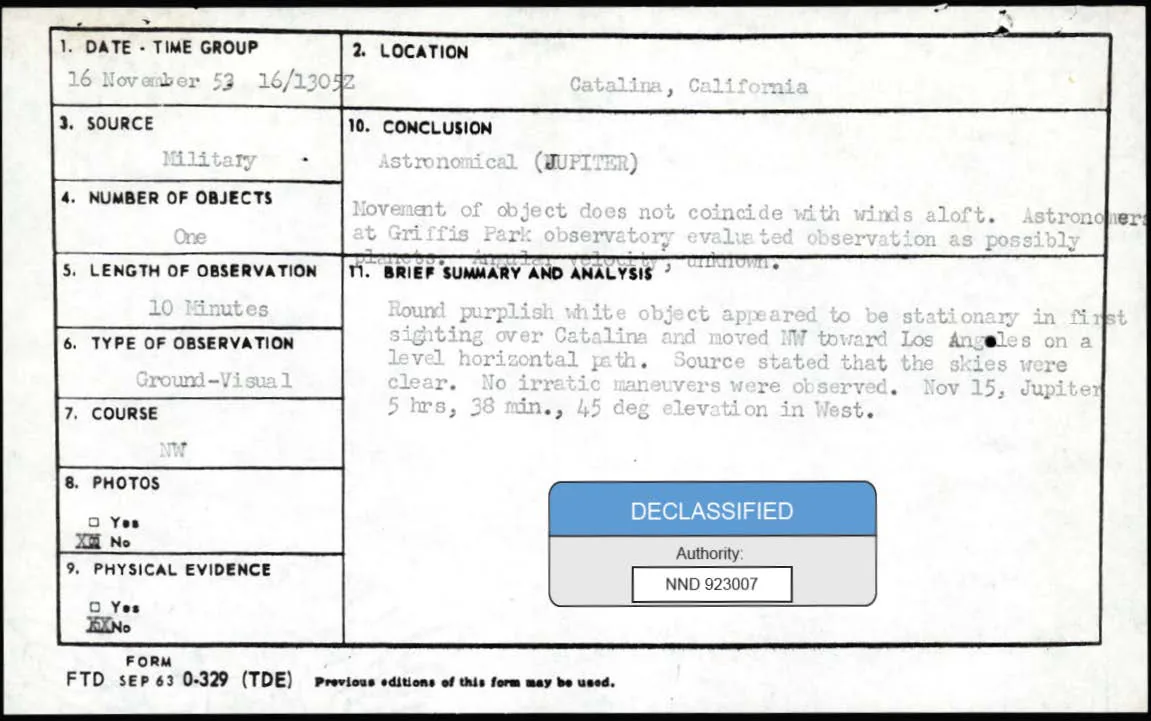
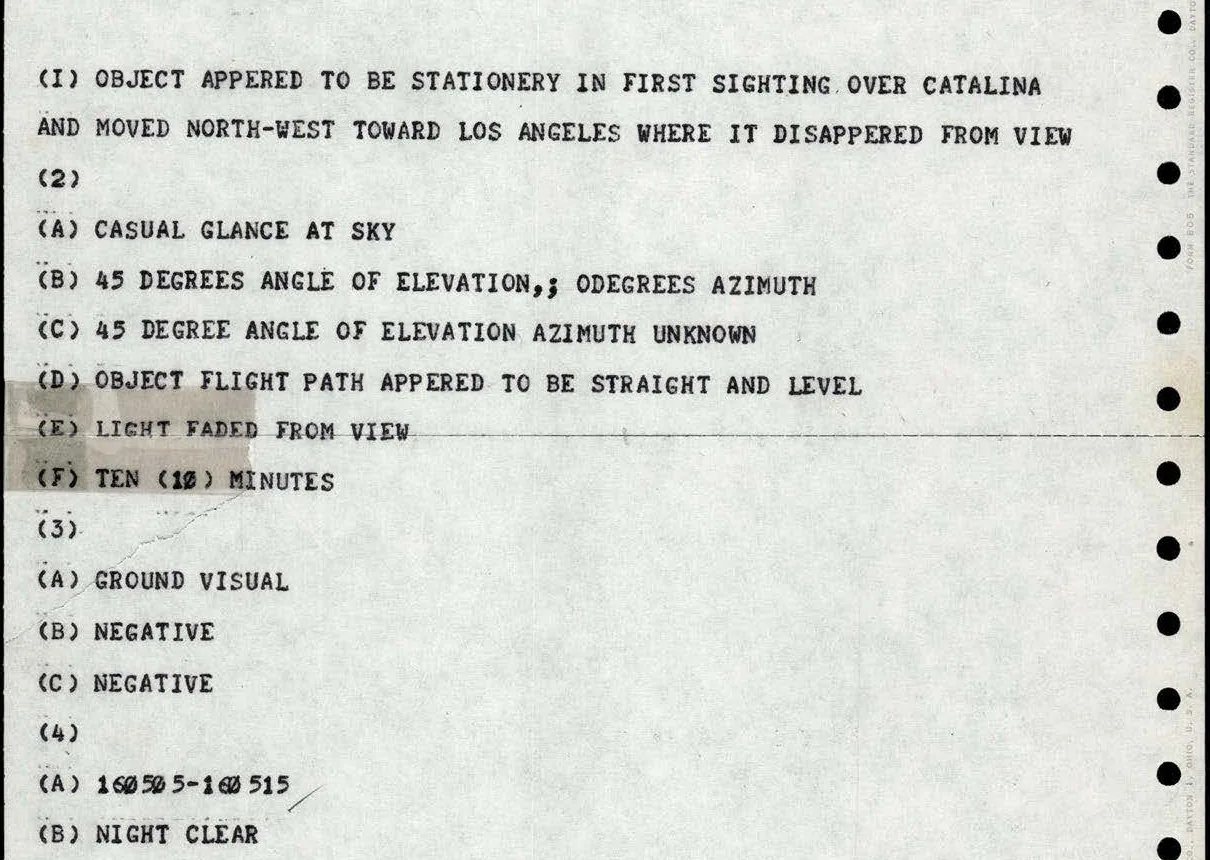
There are no photos or measurements: it is all what one witness saw with the naked eye. The file is two Air Force records, the Project Blue Book card and the teletype the Long Beach base sent the next day. [1 · p. 1, 3–5]
02 Images from the file
Only images from the records themselves: official pages, charts and photos, and drawings the witnesses handed in. Artist's recreations and AI-generated images are not shown, even when the catalogue includes them. Which images are published
03 Timeline
At 05:05 Pacific time, in San Pedro, the witness glances at the sky and sees a round object “the size of a pea”, purplish white, at 45° elevation, apparently still over Catalina Island. The sky is clear. [1 · p. 3–4]
For ten minutes it moves northwest, “toward Los Angeles”, in a straight, level line, and turns bright white. At 05:15, still at 45° elevation, the light fades. [1 · p. 3–4]
The 2347th reserve training center command, at Long Beach airport, sends a teletype to Air Defense Command, ATIC and Air Force Intelligence. It adds that, according to the astronomers at Griffith Observatory, objects “such as these” are possibly planets, which show more clearly after rain. [1 · p. 3, 5]
In 1963 at the earliest, the form's date, Project Blue Book fills in the case card: “Astronomical (JUPITER)”. It notes that the motion does not match the winds aloft and that Jupiter stood at 45° in the west, using the figure for the 15th. [1 · p. 1]
PURSUE releases the file in its seventh tranche under the title “Unresolved UAP Report”. [3]
04 Hypotheses
Status as stated by the official sources cited. The archive takes no side. What each verdict means
- Compatible
Jupiter
It is Project Blue Book's conclusion. HUME's calculation with JPL's DE421 ephemeris, from San Pedro: at 05:05 Jupiter stood at 45.9° elevation and 268.8° azimuth, due west, and at magnitude −2.7 it was the brightest thing in the sky; over ten minutes it drops 2° and shifts 1.4° north, a slow drift to the northwest. The elevation, time, brightness and course fit. What does not: “over Catalina” (the island lies south-southwest, between 181° and 225°), and the light fading at 45° at 05:15, before nautical twilight, when Jupiter was still plainly visible. [1 · p. 1, 4][2]
- Not assessed
Sirius
No source assesses it; it is HUME's calculation. At 05:05 Sirius, the brightest star, stood at 31° elevation and 217° azimuth: right over Catalina as seen from San Pedro. At that height it twinkles with flashes of colour, which fits a “purplish white” point turning white. But it was not at 45°, and it drifts southwest, not northwest. [1 · p. 3–4][2]
- Unlikely
A balloon
The Project Blue Book card notes that the motion does not match the winds aloft. The teletype gives west-northwest winds (250°–280°), which would have carried a balloon east, not northwest. [1 · p. 1, 5]
- Not assessed
An aircraft flying away
No source assesses it. Ten minutes in a straight, level line until it fades is what a distant aircraft's light would do as it flies away, and it would explain the end better than a star or planet. But the witness mentions no navigation lights, blinking or sound, and nobody checked the traffic at that hour. [1 · p. 3–5]
05 Testimony
“OBJECT APPERED TO BE STATIONERY IN FIRST SIGHTING OVER CATALINA AND MOVED NORTH-WEST TOWARD LOS ANGELES WHERE IT DISAPPERED FROM VIEW”06 Editor's reading
The editor's opinion, not an official finding. It rests on the records cited and changes if they do. What each level means
- Conventional explanation likely
- Open
- Anomalous
- Jupiter stood exactly at the elevation the witness gives, 45°, at the exact time, and it was the brightest thing in the sky. Over ten minutes it drifts slowly northwest: what the teletype describes. [1 · p. 4][2]
- The teletype describes nothing a star, a planet or an aircraft could not do: a shapeless point, with no sound and no manoeuvres, seen with the naked eye, and Project Blue Book ruled out a balloon because it did not move with the wind. [1 · p. 1, 3–4]
- What does not fit is the direction and the end: Jupiter was in the west, not “over Catalina”, and it does not go out at 45° before dawn. But the teletype itself gives two opposite directions, and a distant aircraft flying away would explain the end. [1 · p. 4]
- PURSUE releases it as unresolved, but the file holds a single witness, ten minutes and no measurements. Nothing in it calls for an out-of-the-ordinary explanation. [3][1 · p. 1, 3–5]
— Isaac Chaves, editor · Reading of
07 Discrepancies between sources
- The status: PURSUE titles it “Unresolved UAP Report” and its description presents Jupiter as “a possible explanation”; the Project Blue Book card had closed it as “Astronomical (JUPITER)”. [3][1 · p. 1]
- The place: the card and the catalogue say “Catalina, California”, but the witness was in San Pedro, about 40 km away, looking toward the island. [1 · p. 1, 4][3]
- The direction: the teletype puts the object “over Catalina”, which from San Pedro lies south-southwest, and on the next line at “0 degrees azimuth”, due north. “Toward Los Angeles” is north too, not northwest. Jupiter was in the west: 45°–85° from the island and 90° from the noted azimuth. [1 · p. 4][2]
- The astronomers: the teletype records a general opinion from Griffith Observatory (“objects such as these are possibly planets”), not an analysis of this sighting; the card turns it into “evaluated observation as possibly planets”. The specific check, Jupiter at 45° in the west, was made by whoever filled in the card, using the figure for the 15th at 5:38. [1 · p. 1, 5]
08 The case in PURSUE
How PURSUE publishes this case: its official description and every record, with links to the files. Reproduced as is, catalogue errors included.
Official description
The file contains a report of a round, purplish-white object above Catalina Island on November 16, 1953. The report describes the object as remaining stationary, then moving northwest toward Los Angeles over approximately 10 minutes on a level flight path. The report characterizes the observer as fairly reliable due to his association with military jet aircraft activities while stationed at Long Beach Air Force Base, Los Angeles, CA. The report refers to an assessment by local astronomers that Jupiter provided a possible explanation.
Catalogue records · 1
DOW-UAP-D178 · Document · Department of War · Oct 23, 2026
Unresolved UAP Report, Catalina Island, 1953
11/16/53 · Catalina Island, California
09 Sources
- [1]
Record · U.S. Department of War · PURSUE (U.S. Air Force, Project Blue Book) · Oct 23, 2026
DOW-UAP-D178 · Unresolved UAP Report, Catalina Island, 1953
Project Blue Book card and Air Force teletype (5 pp.): from San Pedro, a sergeant sees a round, purplish-white object at 45° elevation from 05:05 to 05:15, still “over Catalina” and then moving northwest, until it fades. The card closes it as “Astronomical (JUPITER)”.
Checked on Oct 26, 2026 · Open the original ↗
- [2]
Report · NASA Jet Propulsion Laboratory · W. M. Folkner, J. G. Williams, D. H. Boggs · Aug 15, 2009
The Planetary and Lunar Ephemeris DE 421 (IPN Progress Report 42-178)
Technical report on JPL's DE421 ephemeris, the computed positions of the planets and the Moon. HUME uses it to compute the sky on a case's date: Colorado in 2023 (with the Hipparcos star catalogue), Catalina in 1953 and 1955, the Sun over Sweden in 1953 and over Azerbaijan in 1955, and dawn over Kazakhstan in 1994.
Checked on Oct 19, 2026 · Open the original ↗
- [3]
Record · U.S. Department of War
Presidential Unsealing and Reporting System for UAP Encounters (PURSUE)
Department of War program, supported by ODNI, that releases declassified records of unresolved UAP cases from several agencies in tranches. None of the three Navy videos is in it.
Checked on Oct 4, 2026 · Open the original ↗
10 How to cite
You may reuse this analysis by crediting HUME with a link to this page. The official documents are public domain. License and reuse
HUME. “A purplish-white object over Catalina (California, 1953) · DOW-UAP-D178”. Published Oct 26, 2026. http://localhost:3000/en/sensor-room/dow-uap-d178 · CC BY-NC 4.0.
May contain errors by the AI and the editor · always check the official source. · Method · Privacy · License