DOW-UAP-D177
UnresolvedAn orange light falling near Catalina (California, 1955)
At night, from Avalon, a resident sees a round, very bright light that turns from orange to red and falls in a straight line from 45° elevation to 10° over the sea, where it goes out. It all lasts two seconds. The officer who wrote the report and the Air Force card put it down to a meteor. HUME has calculated that no planet and not the Moon lay in that direction.
- Date
- Mar 15, 1955
- Location
- Avalon, on Catalina Island (California), looking north-northwest, out to sea toward Santa Monica BayIt covers the witness, in Avalon, and the sea they were looking toward. A meteor has no fixed place: it burns tens of kilometres up and may be much farther away.See the area on the globe →
- Platform
- From the ground, with the naked eye · a civilian Avalon resident who “just happen to notice” [1 · p. 3]
- Sensor
- Human eye · no photos or instruments [1 · p. 1, 3]
- Official status
- Unresolved · PURSUE releases it as an “Unresolved UAP Report”, but the Project 10073 card had closed it as “Meteor” and the UFOB card as “Possibly Astronomical” [4][1 · p. 1–2]What each status means →
01 Sensor readout
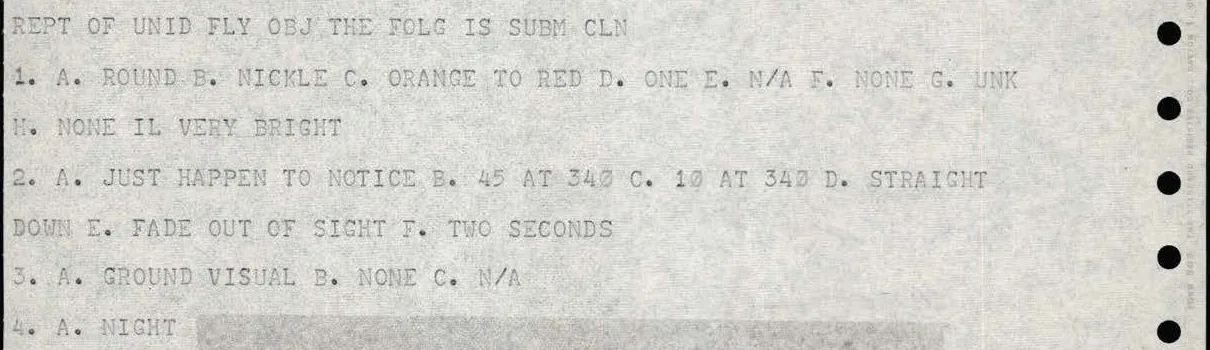
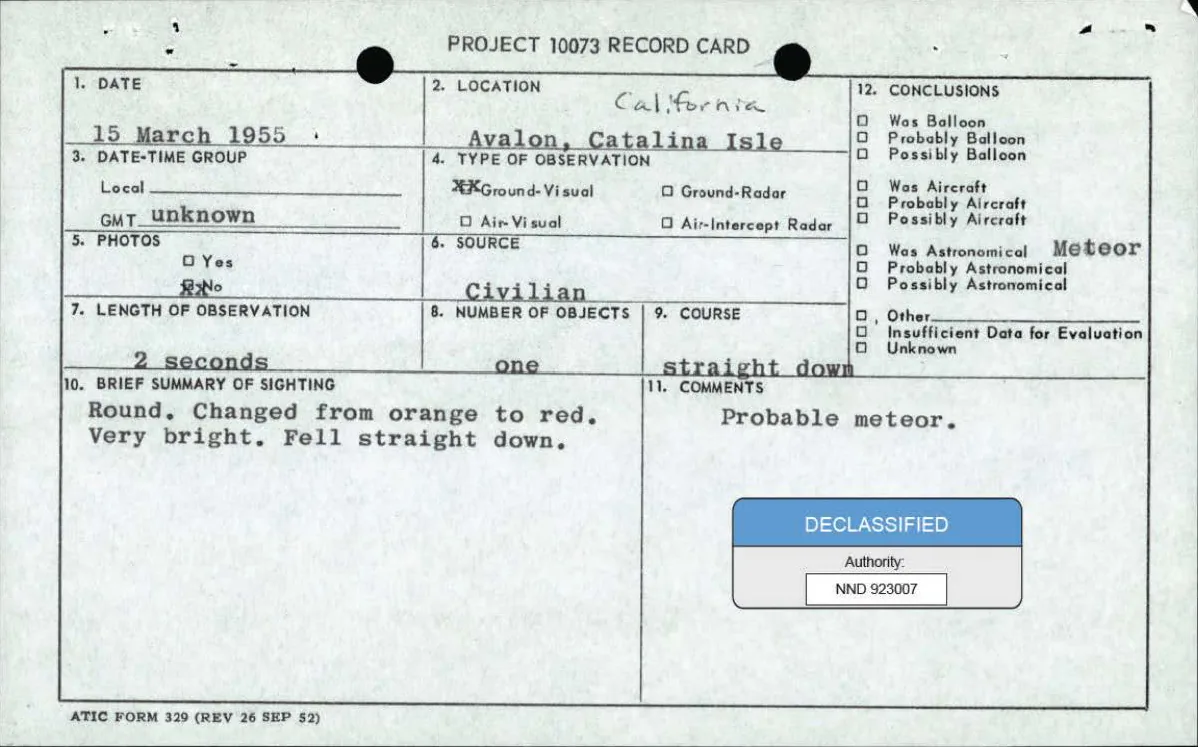
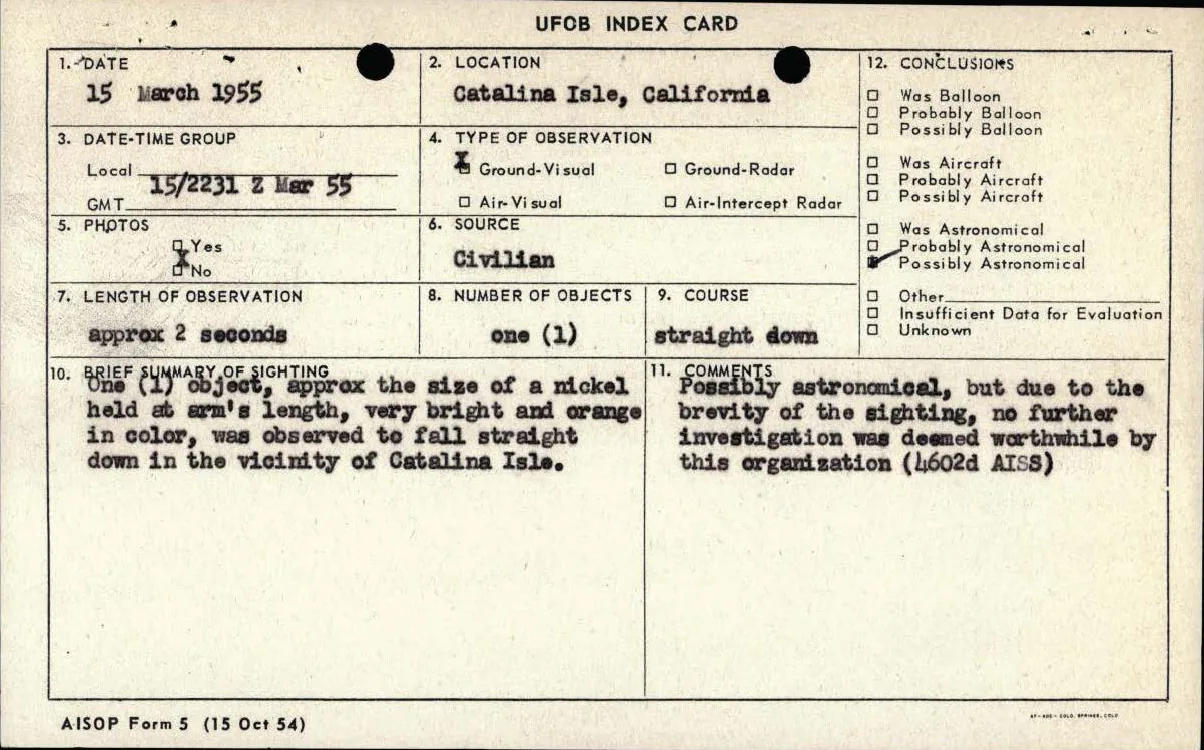
There are no photos or measurements: it is all what one witness saw for two seconds. The file is three Air Force records: the teletype from the San Pedro radar squadron and two cards that summarize it. [1 · p. 1–4]
02 Images from the file
Only images from the records themselves: official pages, charts and photos, and drawings the witnesses handed in. Artist's recreations and AI-generated images are not shown, even when the catalogue includes them. Which images are published
03 Timeline
At night, under a clear sky, an Avalon resident happens to see a round, very bright light, the size of a nickel at arm's length. It is at 45° elevation to the north-northwest, falls in a straight line, turns from orange to red and goes out 10° above the horizon. It lasts two seconds. If the teletype's times are right, it was the night of the 14th to the 15th. [1 · p. 3–4]
The 670th Aircraft Control and Warning Squadron, in San Pedro, sends a teletype to Air Defense Command, ATIC and Air Force Intelligence. Its intelligence officer, a captain, concludes that the path and the duration suggest it was “probably a meteor”. [1 · p. 3–4]
The Air Force summarizes it on two cards: the Project 10073 card closes it as “Meteor”; the 4602d AISS's UFOB card as “Possibly Astronomical”, with no further investigation because the sighting was so brief. [1 · p. 1–2]
PURSUE releases the file in its seventh tranche under the title “Unresolved UAP Report”. [4]
04 Hypotheses
Status as stated by the official sources cited. The archive takes no side. What each verdict means
- Compatible
A fireball (a very bright meteor)
It is the conclusion of the officer who wrote the teletype (“probably a meteor”) and of the Project 10073 card (“Meteor”). The American Meteor Society defines a fireball as a meteor brighter than magnitude −4 and says it usually lasts only a few seconds. The two seconds, the brightness, the straight fall, the orange-to-red colour and the light going out near the horizon all fit. [1 · p. 1, 3–4][2]
- Not assessed
A planet, a star or the Moon
No source assesses it separately; it is HUME's calculation with JPL's DE421 ephemeris, from Avalon, for the night of the 14th to the 15th. No planet and not the Moon lay near azimuth 340°: Mars set in the west at about 9:45 PM, Jupiter crossed the south and set around 290°–295°, and the Moon and Saturn moved from east to south. Besides, no star or planet falls 35° in two seconds. The UFOB card's “possibly astronomical” can only mean a meteor. [1 · p. 2–3][3]
- Not assessed
A flare or a falling aircraft
No source assesses it and nobody checked what was flying that night. A flare falls much more slowly than 35° in two seconds, unless it is very close. The teletype mentions no sound, smoke or debris, and the file records no accident. [1 · p. 3–4]
05 Testimony
“JUST HAPPEN TO NOTICE B. 45 AT 340 C. 10 AT 340 D. STRAIGHT DOWN E. FADE OUT OF SIGHT F. TWO SECONDS”06 Editor's reading
The editor's opinion, not an official finding. It rests on the records cited and changes if they do. What each level means
- Conventional explanation likely
- Open
- Anomalous
- Two seconds, a straight fall from 45° to 10° in the same direction and a light that goes out near the horizon: that is what a fireball does, and the American Meteor Society says one usually lasts only a few seconds. [1 · p. 3][2]
- Those who read the report at the time reached the same answer: the intelligence officer who wrote it put “probably a meteor”, and the Project 10073 card closes it as “Meteor”. [1 · p. 1, 4]
- No planet and not the Moon lay in that direction, and no fixed star or planet falls like that. The only “astronomical” thing that fits is a meteor. [3][1 · p. 2–3]
- PURSUE releases it as unresolved, but the file holds a single witness, two seconds and no measurements, and nothing in it calls for an out-of-the-ordinary explanation. What stays open is small: the exact night, and whether anyone else saw the fireball. [4][1 · p. 1–4]
— Isaac Chaves, editor · Reading of
07 Discrepancies between sources
- The status: PURSUE titles it “Unresolved UAP Report”; the Project 10073 card had closed it as “Meteor” (“Probable meteor”) and the UFOB card as “Possibly Astronomical”. [4][1 · p. 1–2]
- Who said what: PURSUE's description attributes “possibly astronomical” to the officer who prepared the report. That officer wrote “probably a meteor”; “possibly astronomical” and the decision not to investigate further come from the 4602d AISS's UFOB card. [4][1 · p. 2, 4]
- The night: PURSUE says “the evening of March 15, 1955”. The teletype only says “NIGHT”, and it is dated 151900Z and sent at 152231Z, that is, 11:00 AM and 2:31 PM on the 15th, Pacific time. If those times are right, the sighting was on the night of the 14th to the 15th (HUME's inference). [4][1 · p. 3–4]
- The UFOB card's time: its date-time group, “15/2231 Z Mar 55”, is the teletype's transmission time, not the time of the sighting. The Project 10073 card says “GMT unknown”. [1 · p. 1–2, 4]
- The colour: PURSUE says “bright orange”; the teletype and the Project 10073 card say it turned from orange to red. Only the UFOB card keeps just “orange”. [4][1 · p. 1–3]
08 The case in PURSUE
How PURSUE publishes this case: its official description and every record, with links to the files. Reproduced as is, catalogue errors included.
Official description
The file contains a report by Paul J. Carr of Avalon, California, who reported observing a bright orange object, approximately the size of a nickel held at arm’s length, on the evening of March 15, 1955. The provisional assessment associated with the report includes a comment from the preparing officer that the sighting is possibly astronomical, and that the incident did not warrant further investigation.
Catalogue records · 1
DOW-UAP-D177 · Document · Department of War · Oct 23, 2026
Unresolved UAP Report, Catalina Island, 1955
3/15/55 · Catalina Island, California
09 Sources
- [1]
Record · U.S. Department of War · PURSUE (U.S. Air Force) · Oct 23, 2026
DOW-UAP-D177 · Unresolved UAP Report, Catalina Island, 1955
Project 10073 record card, UFOB index card and Air Force teletype (4 pp.): at night, from Avalon, a civilian sees a round, very bright light, orange to red, falling straight from 45° to 10° elevation to the north-northwest in two seconds. The teletype calls it “probably a meteor”; the cards, “Meteor” and “Possibly Astronomical”.
Checked on Oct 27, 2026 · Open the original ↗
- [2]
Report · American Meteor Society
Fireball FAQs
The American Meteor Society's fireball FAQ: a fireball is a very bright meteor, brighter than magnitude −4, that usually lasts only a few seconds; its colours range from red to blue.
Checked on Oct 27, 2026 · Open the original ↗
- [3]
Report · NASA Jet Propulsion Laboratory · W. M. Folkner, J. G. Williams, D. H. Boggs · Aug 15, 2009
The Planetary and Lunar Ephemeris DE 421 (IPN Progress Report 42-178)
Technical report on JPL's DE421 ephemeris, the computed positions of the planets and the Moon. HUME uses it to compute the sky on a case's date: Colorado in 2023 (with the Hipparcos star catalogue), Catalina in 1953 and 1955, the Sun over Sweden in 1953 and over Azerbaijan in 1955, and dawn over Kazakhstan in 1994.
Checked on Oct 19, 2026 · Open the original ↗
- [4]
Record · U.S. Department of War
Presidential Unsealing and Reporting System for UAP Encounters (PURSUE)
Department of War program, supported by ODNI, that releases declassified records of unresolved UAP cases from several agencies in tranches. None of the three Navy videos is in it.
Checked on Oct 4, 2026 · Open the original ↗
10 How to cite
You may reuse this analysis by crediting HUME with a link to this page. The official documents are public domain. License and reuse
HUME. “An orange light falling near Catalina (California, 1955) · DOW-UAP-D177”. Published Oct 27, 2026. http://localhost:3000/en/sensor-room/dow-uap-d177 · CC BY-NC 4.0.
May contain errors by the AI and the editor · always check the official source. · Method · Privacy · License